The Foundation of AI Commerce Has a Name
Behind every product recommendation made by ChatGPT, Claude, or Gemini, there’s a quiet standard working in the background — the Agentic Commerce Protocol, or ACP.
It’s not a buzzword.
It’s the technical foundation that allows AI systems to discover, understand, and recommend your products during real conversations.
If you’re a merchant selling online, ACP is how your brand becomes visible in this new era of agentic commerce.
What Is the Agentic Commerce Protocol?
The Agentic Commerce Protocol (ACP) is a universal data format that enables AI agents to interpret and transact with product information safely and accurately.
Think of it like a shared language between your online store and the world’s AI assistants.
When someone asks:
“Find me a pair of noise-canceling headphones under $200,”
ChatGPT pulls from ACP-compliant product feeds — structured data that contains clean, validated information about price, description, inventory, and purchase flow.
Without that structure, your products might as well not exist in the AI ecosystem.
Why ACP Matters for Every Brand
We’re moving from a world where people search for products to one where AI finds products for people.
And that means:
- Your visibility depends on data compliance, not ads.
- Your marketing depends on structured clarity, not creative copy.
- Your customer acquisition depends on AI access, not SEO rankings.
ACP ensures your products can be:
- Read by AI systems
- Reasoned about accurately
- Recommended in natural conversation
- Purchased directly through Instant Checkout
It’s the connective tissue between your catalog and the next generation of commerce platforms.
How ACP Feeds Work
An ACP feed is essentially a structured data export of your products that conforms to specific fields required by the protocol.
Each feed includes:
- Product name, description, and price
- Category and tags
- Images and URLs
- Inventory and availability
- Merchant details and checkout endpoints
When published through platforms like GXO.dev, these feeds are continuously updated, validated, and optimized for AI discoverability.
The result: your products become visible to agents like ChatGPT, Claude, Gemini, and Perplexity — all of which use ACP to interpret commercial data.
The Role of GXO.dev in ACP Feed Creation
GXO.dev automates the entire ACP feed creation and validation process.
Instead of manually formatting JSON or XML files, merchants simply:
- Connect their Shopify, Etsy, Stripe, or BigCommerce store
- Authorize GXO.dev to access their product catalog
- Auto-generate an ACP-compliant feed
- Preview and validate how AI agents interpret each product
- Publish their feed for discovery across multiple AI ecosystems
Each feed is continuously updated, keeping your data synchronized and AI-ready at all times.
How ACP Connects to ChatGPT Instant Checkout
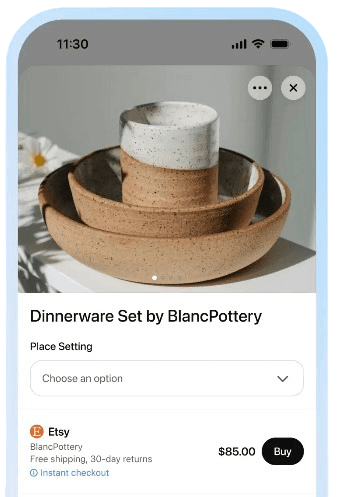
If ChatGPT Instant Checkout is the storefront, ACP is the wiring that makes the lights come on.
When a user decides to buy something inside ChatGPT, ACP ensures that:
- The product’s data is trusted and verified
- Pricing and availability are accurate
- Payment endpoints (like Stripe) connect securely
- The transaction completes instantly
It’s not hyperbole to say ACP is the new backbone of e-commerce — the invisible infrastructure enabling the world’s first truly conversational checkout.
Real-World Example: Shopify’s ACP Integration
When Shopify announced its integration with OpenAI in 2025, ACP became the data layer powering product visibility inside ChatGPT.
Merchants who opted in saw immediate results:
- 27% higher conversion rates from AI-driven queries
- 40% reduction in abandoned checkouts
- New customers discovering products through natural language — not ads
Their data was already there. ACP simply made it understandable.
Why ACP Compliance Matters
AI systems can’t recommend what they can’t read.
ACP compliance ensures:
- Your data includes all required fields (titles, prices, attributes, inventory).
- Your feed structure follows the AI-recognized format.
- Your product metadata is clean, relevant, and validated.
- AI agents can confirm your product’s trustworthiness before showing it to users.
If your store isn’t ACP-compliant, AI agents won’t see your products — no matter how good they are.
It’s the digital equivalent of locking your storefront doors during business hours.
How to Build an ACP Feed the Right Way
If you want to build an ACP feed manually, here’s what you’ll need to include:
Required Fields
- name: Full product name
- description: Human-readable, contextual copy
- price: Numeric value with currency
- image_url: High-quality, accessible product image
- availability: Stock status (in_stock, out_of_stock, preorder)
- checkout_url: Secure payment or cart endpoint
Recommended Fields
- category: Primary and secondary product categories
- tags: Searchable keywords or use cases
- brand: Brand name or manufacturer
- attributes: Materials, sizes, specifications, etc.
- rating: Average customer rating (if applicable)
GXO.dev automatically validates all of these for you — but understanding the structure helps you optimize even further.
ACP Optimization: Beyond Compliance
Being compliant gets you into the AI conversation.
Being optimized gets you recommended.
Optimization focuses on:
- Natural language product descriptions — so AI agents can reason contextually.
- Rich metadata — including use cases, materials, and customer intent.
- Consistent categorization — so AI agents can classify accurately.
- AI-friendly pricing data — consistent currency formats and structured fields.
The goal isn’t to “rank higher.” It’s to make your data so clear that AI can’t misinterpret it.
Common Mistakes to Avoid
If your products aren’t showing up in AI recommendations, here’s why:
- Missing or inconsistent product attributes
- Duplicate or overly complex product descriptions
- Feed not updated frequently enough
- Invalid URLs or broken image links
- Incorrect price or availability formatting
These are all fixable — and GXO.dev’s feed validation tools flag them automatically.
The Strategic Advantage of ACP Adoption
Early adoption of ACP gives your brand first-mover visibility in the new AI discovery layer.
Just like early SEO adopters dominated search rankings in the 2000s, early ACP adopters will dominate AI shopping recommendations in the 2030s.
Your competitors will catch up eventually.
But by then, your products will already be the ones ChatGPT trusts, understands, and recommends.
The Future of Commerce Is Structured
We’ve moved past pages, pixels, and search results.
Now it’s about data, understanding, and trust.
ACP doesn’t replace creativity — it amplifies it.
It takes the story your brand already tells and makes it legible to the most powerful shopping assistants on Earth.
The better your data tells that story, the more often your products will be chosen.
Final Thoughts: Get ACP-Ready Now
ACP isn’t coming — it’s already here.
ChatGPT Instant Checkout, Gemini Commerce, and Claude’s new integrations all rely on it.
The only question left is: will your products be visible in those conversations, or left behind?
With GXO.dev, you can generate and publish your ACP feed in minutes, validate compliance automatically, and position your brand at the forefront of agentic commerce.
Generate Your ACP Feed with GXO.dev
Make your products discoverable to AI agents today.
Connect your store to GXO.dev, generate your ACP-compliant feed, and unlock your brand’s visibility in the next generation of commerce.